

I’ve encountered several media agency models in the last few years, while for a media agency side to moving to the advertiser side.
What I notice though is that there’s an absence of resources online on how media agencies can and should be remunerated. It’s often a mystery for clients that are hiring a media agency (programmatic or other) how these media agencies should be paid.
Agency renumeration is not rocket science but I wanted to share a few models I’ve encountered with their advantages and drawbacks. In this article the focus is on digital media agencies – it’s skewed by my experience with programmatic and search agencies.
Percentage of media spend remuneration
This model is quite common both for agencies and for DSPs.
The way this model works is that you pay a certain percent of your advertising spend as fees.
For example, if you agree on a 10% fee per month and your monthly budget is $100k, then the media agency fee will be $10k/month.
This is a simple model and one that was very popular in the early days of programmatic and is still popular today, especially with holding group agencies like OMD, Publicis, WPP and their ilk. The model can scale well for small to mid size advertisers because at lower budgets your % of media spend will likely remain under control.
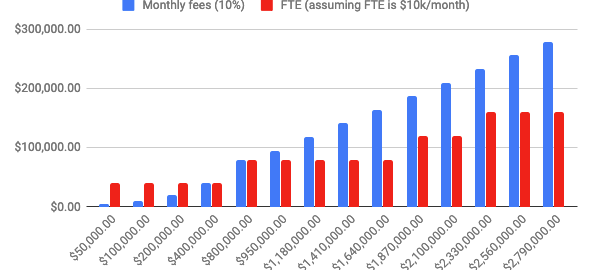
However take a larger advertiser with a higher monthly budget, and the media agency can increase quickly.
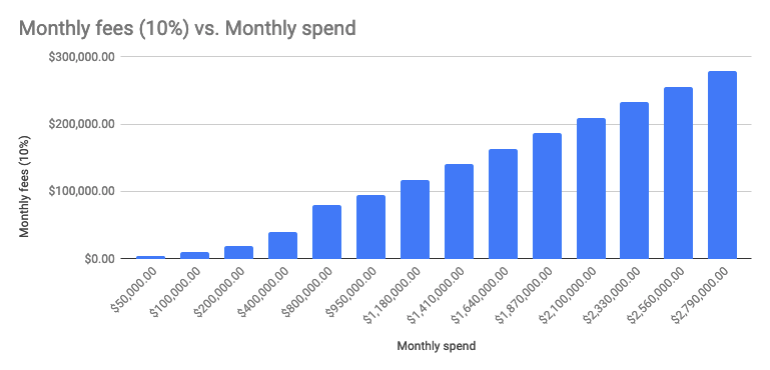
There’s also the matter of what you’re incentivising the media agency to do. In this case, you’re incentivising the agency to focus on spending – the agency’s bottomline (and therefore most of the recommendations you’ll get) will be focused on scaling up spend. In some cases that can lead to inefficient media spend. This can also mean that your agency contacts will be up-selling you on media regularly and asking for spend forecasts (understandably) to keep their line managers informed about how agency revenues from you as a client will evolve.
There’s some variations on this model that include a guaranteed minimum retainer for the agency (for example, you commit to agency fees of $3k/month when your percent of media dips below $3k). This offers some financial guarantee for the agency because they have to staff up your account.
Another often seen variation is that the % of media is tiered. So it may be 10% for the first $100k, then go down to 7% on the second tier between $100k and $200k.
Project based remuneration
Another option is remunerate the agency based on project completion. For example, you’re looking to onboard a DMP and you don’t have the know-how to do it. You can hire an agency (or consultant or freelancer – they are similar when it comes to project work) to do this for you.
In these types of projects, you’ll have to set a start and end date, milestones and completion criteria. The remuneration would likely be a lump sum + ongoing maintenance payments in the case of a DMP (or other pieces of tech) for example.
This type of model is useful as long as the parameters of the projects are crystal clear to you (ie you can recognise when the project is completed). If requirements are not clear, costs on such projects can quickly get out of hand. The term you might hear a lot from your agency under this model is “out of scope”. This means we need more money to do this additional task. Clarifying the parameters of the project will minimise the occurrence of out of scope instances, but if you work in a changing environment where you have to adapt to change constantly (who doesn’t these days), your chances of going over budget can increase.
In the case of simple marketing tech deployment, you can go for this model rather safely (for example reviewing account structure on search advertising – this is a project where most information and decisions would be in your control as a marketer).
For other projects, like a DMP deployment, there’s so many dependencies that can delay and disrupt the project that it’s almost a certainty that it would take more time/effort than you think it should (working with your legal team, billing team, data privacy team, ad tech/engineering team, etc.). This doesn’t mean that remunerating the media agency/consultancy on a project basis is a bad idea – it just means that you have to be realistic about the complexity and expect to pay for it (either at planning or through out-of-scope charges)
People based remuneration
This model pays for man hours or full time employees from the agency to be dedicated to your business. You can pay the agency for FTEs to work on your campaign (whether that’s for trafficking, optimization, reporting or whatever else) – it’s basically outsourcing tasks to freelancers only going through an agency.
This model is good if you can forecast your spend well because you can then do a side by side comparison with something like a % of media model and see what’s best cost wise.
In most cases there will be a point where this model can be more efficient than % of media spend.
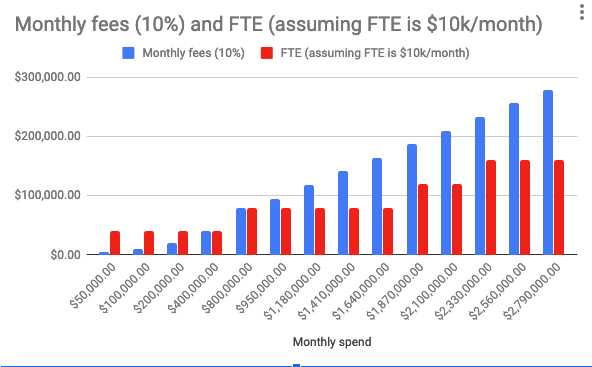
This model has downsides though – if you need more resources it will be often difficult to quickly scale up, there will be a lot more “tracking” needed on your end to figure out how time is being spent and in general if you’re off on your spend forecast you may end up paying more than the % of media model would have cost you. Some agencies will hit “capacity” very quickly as well – you need to be very close to their daily work to manage how time is being spent – that can sometimes be very complicated at scale. You may find yourself spending the majority of your time with your account director (especially the sales-y types) discussing capacity rather than focusing on strategy.
Compared with the % of media spend agency model though, you are not incentivising spend increases. This can free up your agency to push back on unreasonable spend, which is what you want your agency to do. You want your agency to be a custodian of your media spend and to have aligned incentives.
Performance based models
Pay on a CPA, get defrauded.
To expand on that you’re incentivising your agency to claim attribution for conversions to get paid. They will do all they can to do that which often results in attribution fraud due to things like cookie bombing and click spamming.
I may be exaggerating slightly, but in general this model comes at the expense of transparency into media spend, loss of expertise and inaccurate measurement.
In some cases, this model works fine – especially for a new product that has no organic demand. However you have to be extra careful and must have signficant in-house knowledge to pull off managing an agency operating on this model.
Hybrid models
Last but not least, you can come up with your own model. Agencies today are looking to be more adaptable and because of that you could be able to negotiate a model that allows you to both incentivize the behavior that you would like to see in your agency partner as well as your business goals. I would strongly encourage you to sit down with your potential agencies and ask for their recommendation to achieve your business goals. In many cases you’ll be pleasantly surprised.
Any other models you’ve run into that you think are interesting? Leave them in the comments.
Dear Hanna,
As I found this a very useful piece of content, both from an agency perspective (me) as for advertisers (our clients), I just wanted to leave a comment thanking you for dedicating your time to writing this. As you indicate in the introduction, this content is not really available on the web and helps to create a more transparent industry.
Additional useful information would be what agencies are charging more or less:
– Avg. of % of media spend rates by size of agency
– Avg. hourly rates etc.
Potentially overlooked models:
– 0% model – the advantage is the merit: x spend for x results against x CPM’s etc., if the agency is able to negotiate better deals the difference is their payment basically. This could be interesting to get the most out of your agency, but it can lead to allocation of spend where the agency is able to get better deals instead of where it’s best for the campaign.
– Retainer: the fee is basically established as a combo between project based (x-months) and people based (expected hours necessary per month), resulting in a fixed agreed fee for the period of collaboration.
– Lastly I’ve heard of a case with a huge client where the agency actually paid the client to be a client, and they benefited in terms of kick backs with media. Though this doesn’t really benefit the advertiser normally, as the agency would allocate spend where kick backs are highest.
All in all I think the retainer and people based hourly rate remuneration models are most interesting for advertisers as they serve their interest best, as there should not be any alternative incentive for the agency. However if these models are chosen, it’s very important that advertisers understand the effort and time agencies dedicate to campaigns if properly executed, so harsh negotiations on fee’s will negatively impact the quality of the results as agencies are unable to properly allocate internal resources.
Thanks for insight Hugo. Agreed on the retainer and people based models – they tend to align incentives between client and agency in the best way.